MiDOG vs. Culture Testing
MiDOG vs. Culture Testing
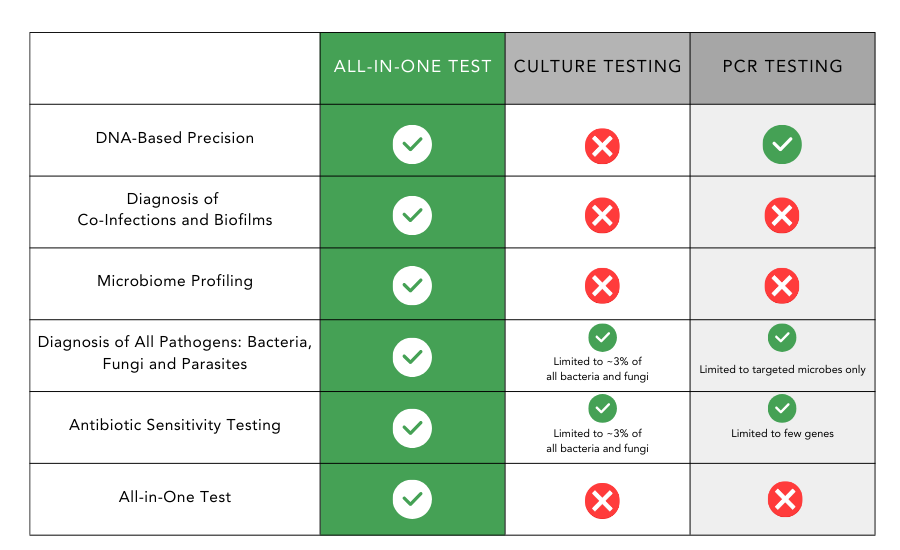
The table below on the left shows how the MiDOG® All-in-One Microbial Test compares to culture testing.
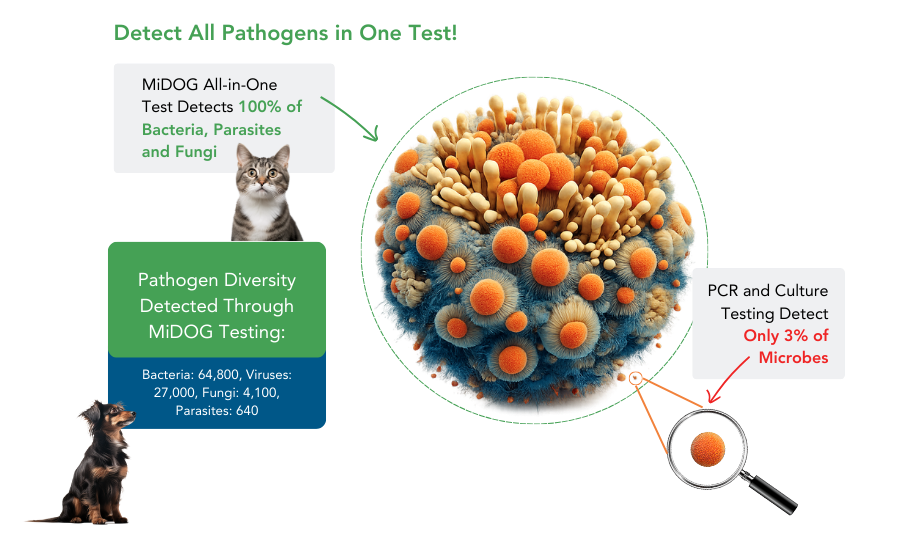
The MiDOG® All-in-One Microbial Test identifies and quantifies all fungi and bacteria present in a sample, and reports on the antibiotic resistance profile. All in just one test.
An Example
Patient Nola, a 3 year old Affenpinscher, was suffering from a urinary tract infection. Her veterinarian, Dr. Michael Morgan from Tustin CA, collected her urine sample via cystocentesis and sent it out for both culturing testing and to the MiDOG® test.
The culture test that Michael received read:

The MiDOG®All-in-One Test showed a huge overgrowth of Proteus mirabilis, a facultatively anaerobic bacteria that the culture test missed:

FAQs About NGS vs Culture
When should veterinarians use NGS instead of PCR for infection testing?
PCR is generally appropriate when a specific pathogen is strongly suspected and a validated targeted assay is available. Veterinarians may consider NGS when the organism is unknown, previous targeted tests are negative or inconclusive, the infection may be polymicrobial, or unusual or difficult-to-culture organisms are suspected. MiDOG’s NGS testing complements PCR, culture, cytology, histopathology and other diagnostic methods rather than replacing every test in every case.
How do DNA-based veterinary infection tests support diagnostic accuracy?
DNA-based infection tests can add diagnostic resolution by identifying microbial genetic material directly from the submitted sample without requiring organisms to grow in culture. Broad NGS can also provide species-level identification and evaluate multiple microbial groups from one sample. Results still depend on sample quality, collection site, timing, microbial burden and prior treatment, and DNA detection does not by itself establish organism viability or disease causation.
Why can standard veterinary infection tests miss persistent pathogens?
Standard tests may miss microorganisms that are slow-growing, fastidious, anaerobic, present at low abundance, intermittently shed, suppressed by previous antimicrobial treatment or absent from a targeted PCR panel. Biofilms and mixed microbial communities may further complicate sampling, recovery and interpretation. Because NGS analyzes microbial DNA without requiring laboratory growth, it can provide additional information in persistent or difficult-to-resolve cases.
What test can help identify pathogens that may be missed or misidentified by traditional methods?
A broad DNA-based test such as the MiDOG All-in-One Test can help identify microbial DNA from organisms that may not grow under routine culture conditions or may not be included on a targeted PCR panel. MiDOG uses next-generation sequencing to evaluate bacteria, fungi, parasites and clinically relevant genomic features from the submitted sample. Findings must be interpreted alongside the patient’s clinical signs, history and other diagnostic results.
What makes recurrent pet infections difficult to diagnose with traditional tests?
Recurrent clinical signs do not always have a single cause. A case may involve relapse, reinfection, resistant organisms, biofilm-associated organisms, a mixed microbial community, inadequate sample representation or an underlying noninfectious condition. Prior antimicrobial treatment can also affect organism recovery. Broader DNA-based testing can help characterize microbial findings, but the veterinarian must determine whether the detected organisms are clinically relevant.