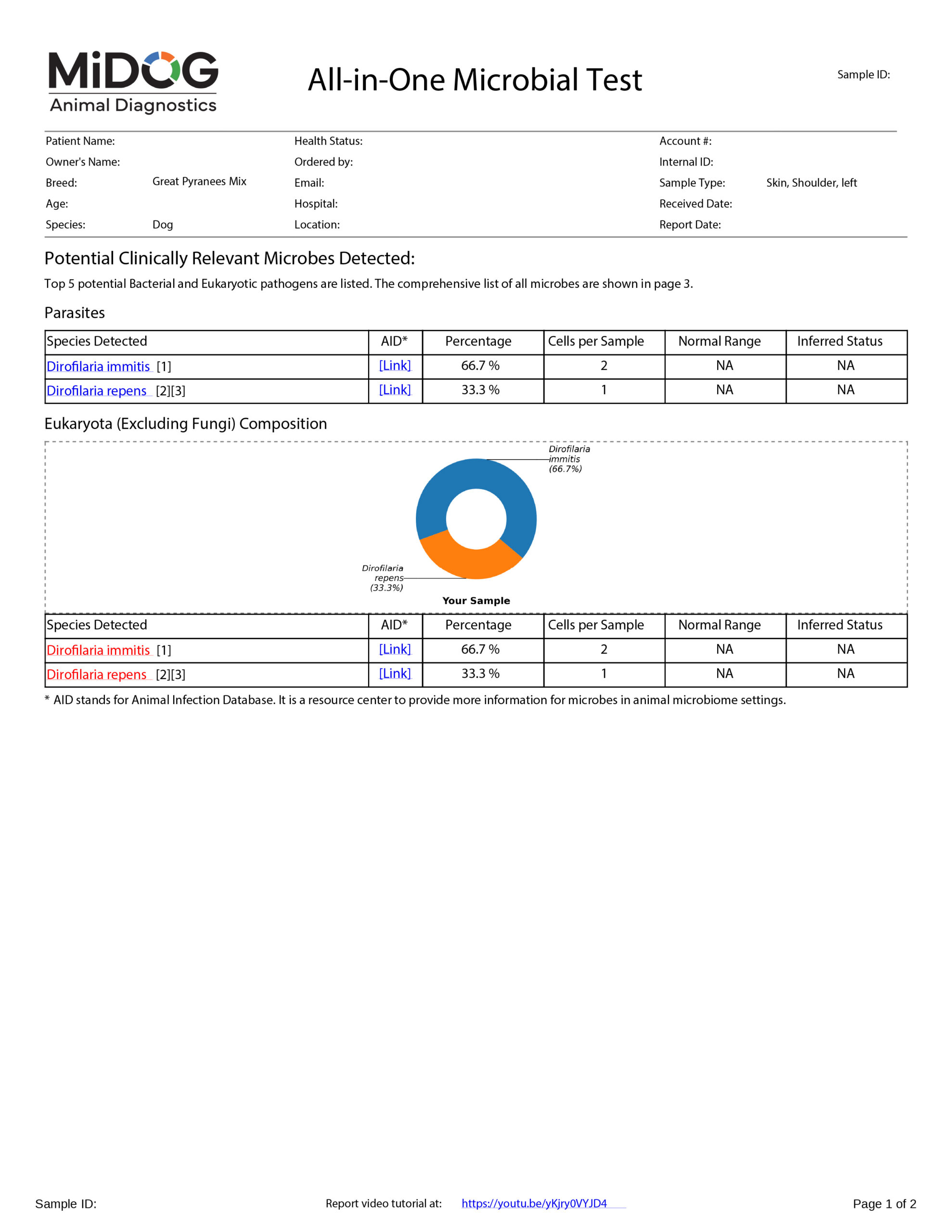
Example Reports
Example Reports
How is the AMR table generated, and how is it different from a traditional culture-based antibiogram?
The AMR table is not generated from a traditional culture-based antibiogram assay. Instead, it combines two complementary sources of information.
First, the table includes curated antibiotic susceptibility information from veterinary textbooks, published studies, and resources such as EUCAST. This provides a literature-based interpretation of which antibiotics are generally expected to be effective or ineffective for a given organism. The advantage of this approach is that it is based on published and validated information. However, the limitation is that some less common, newly described, or poorly characterized organisms may have limited available data, and the information is not specific to the individual patient sample.
Second, when antimicrobial resistance genes are detected in the sample, this sample-specific information is overlaid onto the AMR table. This can provide more directly relevant information for clinical decision-making because it reflects resistance genes detected in that specific sample. It can also help identify resistance potential in organisms that may not be well represented in traditional published antibiogram resources.
The sensitivity of AMR gene detection can vary depending on several factors, including sample type, microbial complexity, and the amount of pathogen DNA present. For example, a cystocentesis urine sample generally provides better sensitivity for pathogen characterization than a free-catch urine sample, which may contain DNA from multiple sources and a more complex microbial background. Therefore, when AMR genes are detected, they provide valuable sample-specific information, but absence of a detected resistance gene does not always guarantee absence of resistance.
Overall, the AMR table represents the best available interpretation by combining curated literature-based susceptibility information with sample-specific antimicrobial resistance gene detection when available.