
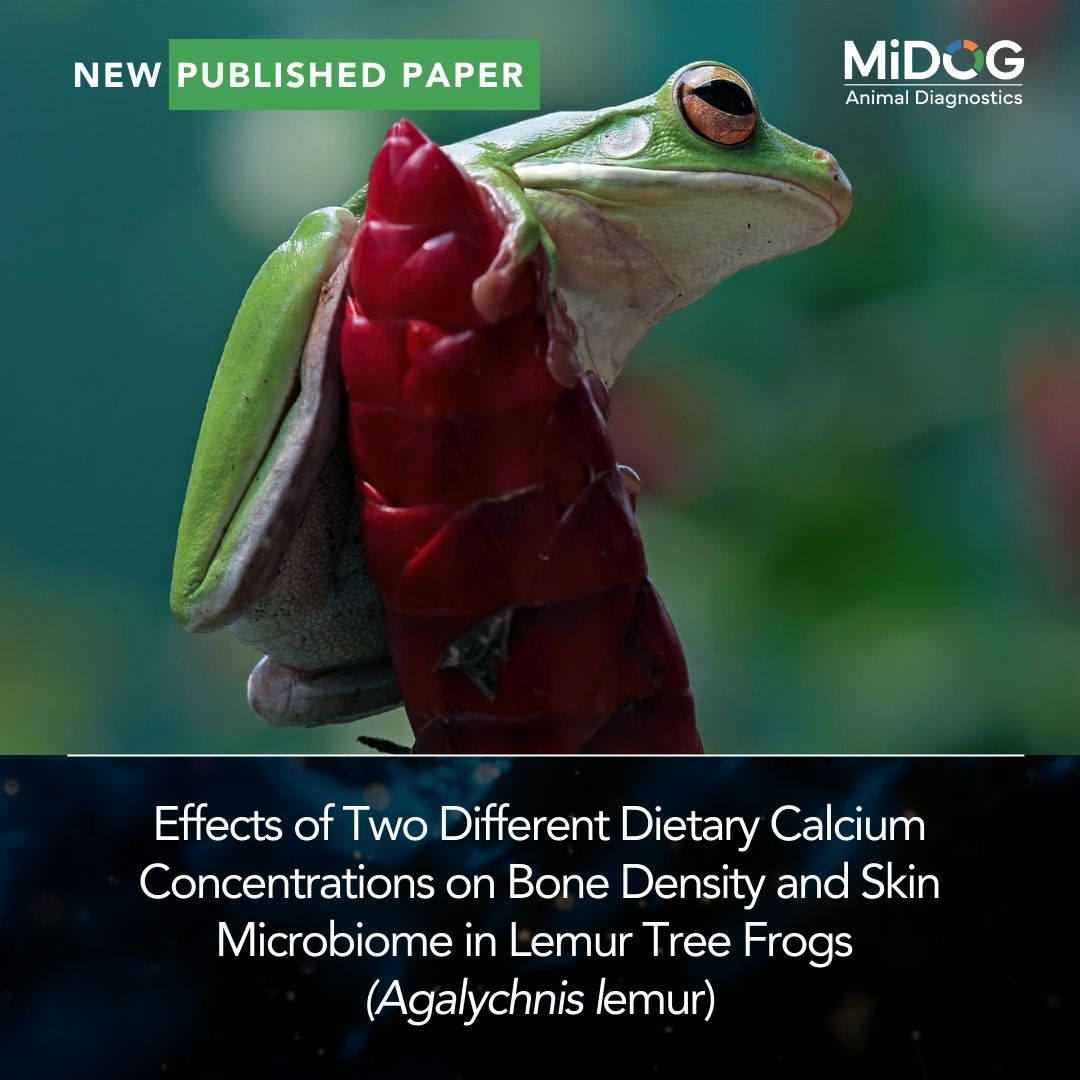
Published Study: Dietary Calcium Increases Bone Density in Lemur Tree Frogs Without Altering Skin Microbiome
MiDOG Animal Diagnostics is pleased to share our latest peer-reviewed publication in Animals (MDPI): “Effects of Two Different Dietary Calcium Concentrations on Bone Density and Skin Microbiome in Lemur Tree Frogs (Agalychnis lemur).”
🔗 Read the full paper here: Read the Paper Here
What this study asked (and why it matters in ex situ amphibian care)
Maintaining threatened amphibian species under human care often comes down to the fundamentals: nutrition, bone health, and husbandry stability. Calcium balance is a known risk factor in amphibians, yet there’s been limited species-specific data linking dietary calcium to objective measures of skeletal development, especially in Agalychnis spp.
This study evaluated whether two cricket gut-loading diets, 1.3% calcium vs 8% calcium, produce measurable changes in:
-
Whole-body bone density over time (via micro-computed tomography, reported as Hounsfield units)
-
Skin bacterial and fungal communities (skin microbiome) are an increasingly important aspect of amphibian health and disease resilience
Study design at a glance
Species: Lemur tree frogs (Agalychnis lemur)
Population: 11 juvenile frogs (subadults at study start)
Duration: 180 days
Diet intervention: Frogs were fed crickets gut-loaded with either:
-
Control: 1.3% calcium diet
-
Treatment: 8% calcium diet
Outcome measures:
-
Bone density (HU) using micro-CT at baseline, ~90 days, and 180 days
-
Skin microbiome profiling (bacteriome + mycobiome), assessing alpha and beta diversity
Key finding 1: Higher dietary calcium significantly increased bone density
Whole-body bone density (HU) changed significantly over time and differed between diet groups. Frogs consuming the 8% calcium gut-loaded crickets showed significantly higher whole-body HU compared with those consuming the 1.3% calcium diet.
Clinical relevance: For zoological medicine teams and amphibian programs, this supports a practical, evidence-based nutrition lever, gut-loading calcium concentration, to support skeletal development during growth phases.
Key finding 2: Skin microbiome diversity did not meaningfully shift by calcium concentration
A core question in amphibian medicine is whether diet-driven changes could influence the gut–skin axis and downstream skin microbial communities (especially given the clinical importance of skin health in amphibians).
In this study:
-
Bacterial and fungal alpha diversity did not significantly differ by diet group
-
Fungal beta diversity did not show significant group differences
-
Observed bacterial community changes were primarily associated with sampling time, not the calcium group
Clinical relevance: Increasing calcium concentration via gut-loading, at least at the levels tested, did not appear to disrupt overall skin microbial diversity patterns, which is reassuring for programs optimizing mineral nutrition.
Why this matters for clinicians and researchers
For clinicians (zoo/exotics/wildlife medicine)
This paper provides real-world, actionable support for a common challenge in amphibians: bone health risk management.
If you’re managing:
-
Juvenile growth phases
-
Suspected mineral imbalance
-
Husbandry transitions in threatened species programs
-
Long-term maintenance diets where “adequate calcium” is assumed but not validated
…this study reinforces that gut-loading strategy matters and can translate into measurable skeletal outcomes.
For researchers (amphibian health + conservation programs)
The work adds to the growing evidence base connecting:
-
nutrition → morphology (bone density)
-
nutrition → microbial ecology (skin microbiome)
…and helps define what doesn’t shift under controlled interventions—important for designing future studies targeting microbiome manipulation, disease resistance, and environmental stability.
How MiDOG contributed
MiDOG Animal Diagnostics supported this work through microbial sequencing and analytical expertise focused on amphibian microbial ecology—helping generate high-resolution bacterial and fungal community insights relevant to both clinical interpretation and conservation research.
Read the publication
If you support amphibian health in clinical practice, conservation, or research, we encourage you to review the full paper and share it with your team.
FAQs
Does higher calcium gut-loading affect amphibian skin microbiome?
In this study, calcium concentration did not significantly alter bacterial or fungal alpha diversity, and fungal beta diversity did not differ by group.
Why measure bone density in Hounsfield units (HU)?
HU provides an objective, imaging-based metric for comparing changes in skeletal density over time, useful for longitudinal monitoring.
What’s the practical takeaway for amphibian diet planning?
Calcium gut-loading concentration can materially impact bone density outcomes during growth, supporting more intentional nutrition protocols in managed care.