
A major outbreak of kidney disease called leptospirosis has affected more than 200 California sea lions this year. Caused by the bacterial genus Leptospira, the disease has a high mortality rate in sea lions. One unusual sign is that infected sea lions are often seen drinking water, something they typically do not do, as they normally get all their hydration from the food they consume. Sadly, even with treatments, two-thirds of infected sea lions do not survive. Leptospirosis outbreaks tend to occur every four to five years, usually affecting over 100 sea lions. This year’s outbreak arrived 6 to 8 weeks earlier than expected, with no end in sight, raising serious concerns among experts (1).
Why Pet Owners Should Care
Leptospira isn’t just a sea lion problem. The bacteria can be transmitted through bodily fluids, especially urine. Not only that, this pathogen is zoonotic, meaning it can infect both humans and pets. Leptospira infection is a concern for dogs, as it can lead to permanent organ damage and may be life-threatening. Cats are usually asymptomatic or show only mild symptoms, but they can still shed the bacteria and spread it to other pets and people (2).
Experts recommend:
- Keeping dogs on leash at the beach.
- Preventing dogs from drinking sea water.
- Avoiding close contact between pets and sea lions or other marine animals.
Leptospira infects more than 150 mammalian species. Sub clinically and chronically infected animals can serve as reservoir hosts and shed Leptospira mainly through urine and contaminate soils and water (3,4). There are over 250 pathogenic serovars based on their lipopolysaccharide composition, and serovars are adapted to different animal reservoir hosts. Pets acquire infection through direct contact with infected hosts or their urine, or by indirect contact with contaminated soil or water. Infections of cats occur mainly through hunting rodents (2).
Symptoms in Pets
Symptoms of Leptospirosis in dogs and cats are nonspecific (5,6). Most common signs of infection include:
- Loss of appetite
- Vomiting
- Lethargy
- Abdominal pain
- Diarrhea
- Jaundice
- Dehydration
- Drinking or urinating more than usual
- Weight loss
- Stiffness or muscle pain

Leptospira enters the body through skin or mucous membranes and breaks down endothelial cell barriers. The bacteria can damage kidneys and liver and invade other organs and cause systemic inflammation. It can lead to pneumonia, pancreatitis, bleeding disorders, or even sepsis (7). While many dogs show mild or no symptoms, some cases are life-threatening. Compared to dogs, clinical disease is less commonly observed in cats, and symptoms are at most mild. But infected cats can still shed the bacteria without displaying any symptoms and cause serious disease in humans and dogs that cohabit.
Diagnosis in Pets
For Diagnosis of leptospirosis in dogs, combination of serological test and DNA-PCR test is recommended as each test has their own limitations (7).
- The microscopic agglutination test (MAT) is used to detect the presence of antibodies against Leptospira bacteria in the blood. Although MAT can test several different serovars of Leptospira, it takes a relatively long time to confirm an infection, as at least two tests spaced one to two weeks apart are typically required. False-negative results are highly likely as not all pathogenic serovars are tested in the panel.
- PCR testing can detect Leptospira DNA in bodily fluids and can get results quicker than the MAT test. Submission of both blood and urine samples is recommended for DNA-PCR test, prior to administering antibiotics. PCR tests cannot determine serovars. Use of antibiotics and intermittent shedding of Leptospira in urine will lead to false-negative results.
- ELISA can also be used for detection of Leptospira antibodies in dogs, and it can detect antibodies earlier than MAT, and against all serovars, between 4-6 days post infection. False-positive results may occur if dogs were previously vaccinated.
For diagnosis of Leptospirosis in cats, MAT or DNA-PCR test for urine and blood can be used, but no rapid tests, including ELISA, are currently available for cats (2).
Treatment
Dogs: In dogs, doxycycline is the preferred antibiotic for treating leptospirosis. If doxycycline is not well tolerated, alternatives such as ampicillin, amoxicillin, or penicillin G may be used. After the initial microbial therapy of 2 weeks, administration of Doxycycline for 2 more weeks is recommended to eliminate the carrier phase of infection. IV fluid and electrolyte supplementation may be needed for supportive care, dialysis or liver support medications are needed for patients with kidney and liver damage. Dogs with severe respiratory disease are less likely to survive.
Cats: Similar antibiotic approaches can be used, after symptoms are stabilized, 6 weeks of doxycycline treatment is recommended for eliminating carrier phase (6).
Prevention
Dogs: Vaccination is considered the most effective preventative measure. There are 2,3,4 serovar vaccines depending on the region, but 4 serovar vaccines are recommended in general. Leptospirosis is prevalent in dogs that are unvaccinated or vaccinated with 2 serovar vaccines. All dogs starting from12 weeks should receive Leptospira vaccines annually (8).
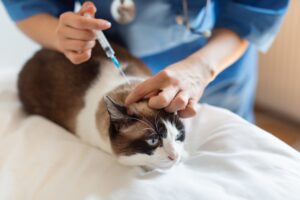
Cats: There are no vaccines available for cats. The best preventative measure for cats is to limit exposure to infected hosts or contaminated environments. Cats kept indoors have a lower risk of getting exposed to Leptospira, as hunting rodents, contacting farm and wild animals, drinking from stagnant water all greatly increase the risk of infection (9).
A New Testing Option
MiDOG All-in-One Microbial Test Kit offers a powerful alternative for detecting Leptospira infection in pets. Traditional methods such as MAT have long turnaround time and are limited to only a few serovars, while PCR, though faster, can yield false negatives due to low bacterial abundance or intermittent shedding. In contrast, MiDOG’s next-generation sequencing (NGS) test provides a comprehensive view of your pet’s microbiome. It can detect Leptospira and other microbes even at low abundance, quantify their cell counts (something other methods cannot achieve), and identify all strains, distinguishing between pathogenic and non-pathogenic types. Importantly, infection can be detected even in asymptomatic animals, helping guide treatment decisions and reducing the risk of transmission to other pets and humans in the household.
References:
- Leptospirosis: Kidney Damage in California Sea Lions https://www.marinemammalcenter.org/science-conservation/research-library/leptospirosis
- Hartmann, K., Egberink, H., Pennisi, M. G., Lloret, A., Addie, D., Belák, S., Boucraut-Baralon, C., Frymus, T., Gruffydd-Jones, T., Hosie, M. J., Lutz, H., Marsilio, F., Möstl, K., Radford, A. D., Thiry, E., Truyen, U., & Horzinek, M. C. (2013). Leptospira species infection in cats: ABCD guidelines on prevention and management. Journal of feline medicine and surgery, 15(7), 576–581. https://doi.org/10.1177/1098612X13489217
- Pappas, G., Papadimitriou, P., Siozopoulou, V., Christou, L., & Akritidis, N. (2008). The globalization of leptospirosis: worldwide incidence trends. International journal of infectious diseases : IJID : official publication of the International Society for Infectious Diseases, 12(4), 351–357. https://doi.org/10.1016/j.ijid.2007.09.011
- Cilia, G., Bertelloni, F., & Fratini, F. (2020). LeptospiraInfections in Domestic and Wild Animals. Pathogens (Basel, Switzerland), 9(7), 573. https://doi.org/10.3390/pathogens9070573
- Leptospirosis in dogs. Leptospirosis in dogs | American Veterinary Medical Association
- Murillo A, Goris M, Ahmed A, Cuenca R, Pastor J. Leptospirosis in cats: Current literature review to guide diagnosis and management. Journal of Feline Medicine and Surgery. 2020;22(3):216-228. doi:1177/1098612X20903601
- Sykes JE, Francey T, Schuller S, Stoddard RA, Cowgill LD, Moore GE. Updated ACVIM consensus statement on leptospirosis in dogs. J Vet Intern Med. 2023; 37(6): 1966-1982. doi:1111/jvim.16903
- Francey T, Schweighauser A, Reber A, Schuller S. Evaluation of changes in the epidemiology of leptospirosis in dogs after introduction of a quadrivalent antileptospiral vaccine in a highly endemic area. J Vet Intern Med. 2020; 34: 2405–2417. https://doi.org/10.1111/jvim.15947
- Mwachui MA, Crump L, Hartskeerl R, et al. Environmental and behavioural determinants of leptospirosis transmission: a systematic review. PLoS Negl Trop Dis2015; 9.