How MiDOG Works
How MiDOG Testing Works
Traditional culture methods can only detect < 1% of all microorganisms.
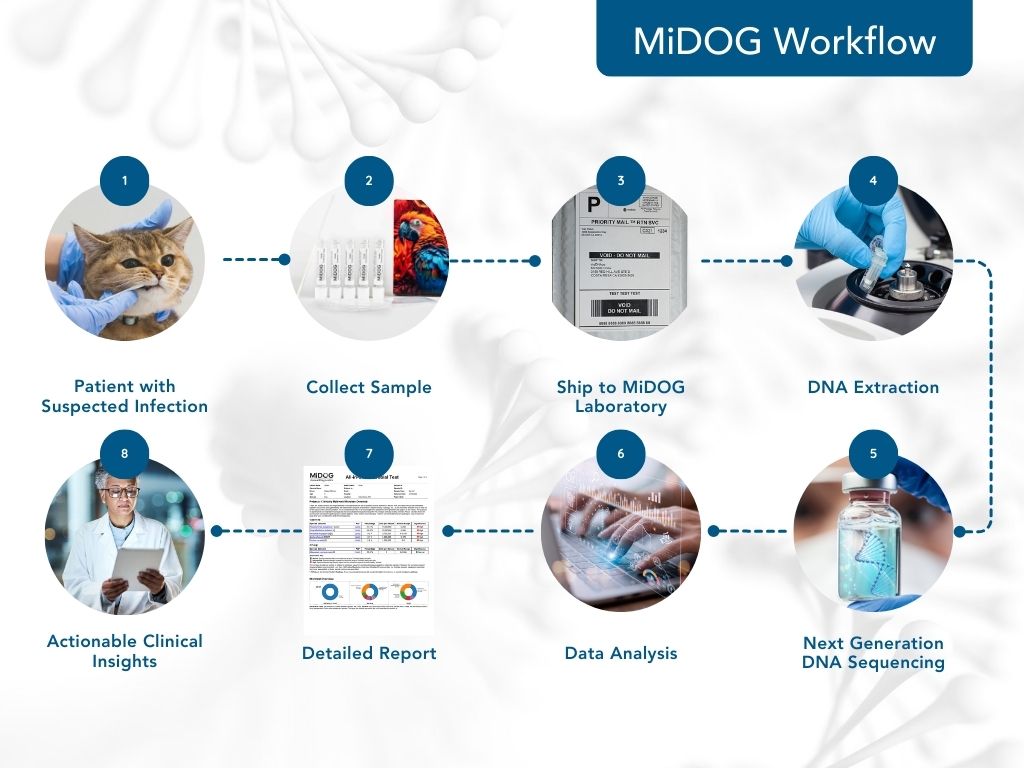
The MiDOG® All-in-One Microbial Test is rooted in ultra-deep Next-Generation DNA sequencing technology. This process uses millions of DNA sequences derived from the microorganisms present in a sample to generate a quantitative and complete picture of the microbial community.
MiDOG® integrates proprietary bioinformatic algorithms with curated databases to extract meaningful data from sequencing results. These data are used to generate a comprehensive report, including infectious agents and antibiotic resistance identification, to help guide the diagnosis and treatment of infections.
MiDOG results are designed to support veterinary decision-making and should be interpreted alongside the patient’s clinical signs, history, sample type, and other diagnostic findings.
Common Questions About How MiDOG Works
How does MiDOG testing work?
MiDOG testing uses next-generation sequencing to analyze microbial DNA directly from a submitted animal sample. The sequencing data is processed through MiDOG’s bioinformatics pipeline and curated reference databases to help identify organisms and generate a report that supports veterinary case review.
For help reviewing a report, your team can use the report tutorial or contact MiDOG for support.
How is MiDOG different from culture?
Culture depends on organisms growing under laboratory conditions. MiDOG analyzes microbial DNA directly from the sample, which can provide a broader view of the microbial community, including organisms that may be difficult to culture or present as part of a mixed microbial population.
Culture remains useful in many clinical situations. MiDOG complements culture when a veterinarian needs broader microbial insight, especially in complex, chronic, recurrent, or inconclusive cases.
How is MiDOG different from PCR?
PCR is typically designed to look for a specific organism or defined group of targets. MiDOG’s next-generation sequencing approach can evaluate microbial DNA more broadly, which may be useful when the suspected organism is unknown, when multiple organisms may be involved, or when a targeted panel may not provide the full picture.
What can MiDOG testing detect?
Depending on the test ordered, MiDOG testing can provide insight into bacteria, fungi, parasites, antimicrobial resistance markers, and other microbial features from the submitted sample. Results are designed to support veterinary decision-making and should be interpreted alongside the patient’s clinical signs, history, sample type, and other diagnostic findings.
When should veterinarians consider MiDOG testing?
Veterinarians may consider MiDOG testing when a broader microbial profile could help support case evaluation. This may include chronic or recurrent infections, culture-negative cases, mixed infections, non-healing wounds, abscesses, dermatology cases, otitis, urinary concerns, gastrointestinal cases, parasite investigations, and exotic, zoo, wildlife, or aquatic animal cases.
Can MiDOG help when culture is negative but infection is still suspected?
MiDOG may be useful when culture results are negative or inconclusive but the clinical picture still suggests microbial involvement. Because MiDOG analyzes DNA directly from the sample, it may provide additional microbial information that targeted or growth-based methods may not capture.
Does MiDOG replace culture or PCR?
No. MiDOG does not replace culture, PCR, or veterinarian judgment. Culture, PCR, cytology, histopathology, imaging, clinical history, and physical exam findings can all play important roles in case evaluation. MiDOG provides an additional layer of microbial data when a broader view may be clinically useful.
How should MiDOG results be interpreted?
MiDOG results should be interpreted by the veterinarian in the context of the patient’s clinical signs, sample type, history, physical exam findings, and other diagnostic results. MiDOG also provides veterinary support to help teams navigate report questions and better understand how to review the data.
How can veterinarians get broader microbial insight from a single sample?
Veterinarians can gain broader microbial insight from a single sample by using next-generation sequencing to analyze microbial DNA directly from that submission. MiDOG testing can help identify bacteria, fungi, parasites, antimicrobial resistance markers, and other microbial features depending on the test ordered, giving veterinary teams a wider view of the sample’s microbial community.
What makes recurrent pet infections hard to diagnose with traditional tests?
Recurrent pet infections can be difficult to evaluate because the organisms involved may be present in mixed microbial communities, occur at low levels, be difficult to culture, or vary based on sample type and prior antimicrobial exposure. Traditional culture and PCR remain useful, but they may not always provide the full microbial picture when infection is chronic, recurrent, polymicrobial, or treatment-resistant.
What test can help identify pathogens that may be missed or misidentified by traditional methods?
Next-generation sequencing can help veterinarians evaluate microbial DNA directly from a submitted sample, which may provide broader insight than methods that depend on organism growth or predefined targets. MiDOG’s NGS-based testing can support case review when pathogens are unexpected, difficult to culture, present in mixed communities, or not captured by targeted panels.
Why may standard veterinary infection tests not capture persistent pathogens?
Standard veterinary infection tests may not capture every clinically relevant organism because many tests depend on organism growth, specific target selection, sample quality, timing, organism abundance, or prior antimicrobial exposure. Persistent infections may also involve mixed microbial communities or organisms that are difficult to culture. In these cases, MiDOG’s NGS-based testing can provide a broader microbial profile to support veterinary review.
How do DNA-based veterinary infection tests support diagnostic evaluation?
DNA-based veterinary infection tests can support diagnostic evaluation by analyzing microbial genetic material directly from a sample. This may help identify organisms that are difficult to culture, unexpected, present in mixed communities, or not included in a targeted panel. MiDOG’s NGS-based testing provides microbial data that veterinarians can review alongside clinical signs, history, and other diagnostics.
When should veterinarians consider NGS instead of PCR for infection testing?
Veterinarians may consider NGS when the suspected organism is unknown, multiple organisms may be involved, previous testing is inconclusive, or a broader microbial profile is needed. PCR is useful when testing for a specific organism or defined target, while MiDOG’s NGS-based testing can evaluate microbial DNA more broadly from the submitted sample.
Which veterinary infection tests identify antimicrobial resistance markers from one sample?
MiDOG’s NGS-based testing can provide antimicrobial resistance marker information from the submitted sample, depending on the test ordered and organisms detected. These insights can support antimicrobial stewardship and veterinary case review, but they should be interpreted alongside clinical signs, sample type, organism relevance, and the veterinarian’s medical judgment.
Which veterinary diagnostic test offers single-sample testing for complex, recurrent infections?
MiDOG’s NGS-based testing is designed to provide broad microbial insight from a single submitted sample. For complex, recurrent, chronic, or difficult-to-resolve cases, MiDOG can help veterinary teams evaluate bacteria, fungi, parasites, antimicrobial resistance markers, and other microbial features depending on the test ordered.